The Internet's Premier Classical Music Source
Related Links
- Recommended Recordings
CD / DVD Reviews - MacMillan Resources:
-
Introduction
Biography
Chronological List of Works
Recordings
Future Performances
World Premieres 1996
World Premieres 1997
-
Find CDs & Downloads
Amazon - UK - Germany - Canada - France - Japan
ArkivMusic - CD Universe
Find DVDs & Blu-ray
Amazon - UK - Germany - Canada - France - Japan
ArkivMusic-Video Universe
Find Scores & Sheet Music
Sheet Music Plus -
Recommended Links

Site News
Site Search
Follow us on


Affiliates









James MacMillan
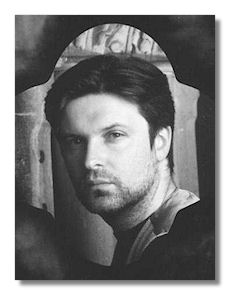
(b. 1959)
Introduction
In 1990, the London Proms was the scene for a truly sensational event, a world premiere performance at a concert given by the BBC Scottish Symphony Orchestra conducted by its principal conductor Jerzy Maksymiuk inserted between Beethoven's Fourth Symphony and Sibelius' Violin Concerto of an orchestral work entitled The Confession of Isobel Gowdie by the Scottish composer James MacMillan. It was a triumph not only because a performance of a work not then a year old was a suprise at the Proms at that time, but also because of the direct, emotionally gripping music it contained.
After what can be described as a conventional beginning as an "academic modernist" concentrating upon "classical" serialism, limited aleotoricism of the type cultivated in Poland and the influence of Peter Maxwell Davis (a composer with whom he has retained close links through their joint educational work in Scotland) MacMillans music underwent a transformation. His output since the 1987 Litanies of Iron and Stone is more direct and accessible. This in conjunction with MacMillans return to his native land completed the circle so to speak on the three decisive components of MacMillans oeuvre, his political and religious convictions (a Socialist and devout Roman Catholic) and sense of national identity and produced a sudden burst of intense creativity.
The Confession of Isobel Gowdie can be said to contain these components, the theme of a woman who was a victim of the Reformation which pursued witch-hunting with vigour, extracted confessions with torture and executed its victims has its parallel with the witch-hunters, whether religious or political who still exist today. Fearful of losing their privileges they attack everything which opposes their aims be they religious communities, political parties or ethnic minorities. According to MacMillan it is the Requiem that was never sung for Isobel Gowdie.
At a 1996 pre-concert interview at the Huddersfield Contemporary Music Festival MacMillans expressed his desire to continue his involvement in the musical education of children, described the scenario for his recently completed opera Inés de Castro, commissioned by the Scottish Opera and for the future outlined a "tryptch" of works to include a symphony. This in a year when the BBC production of Seven Last Words from the Cross won the Royal Philharmonic Society's award for the Best Music Video of the Year, MacMillan was the only classical composer to win a place on the shortlist of ten for the 1995 Mercury Prize, the British music industries equivalent of the Booker Prize and when Veni Veni Emmanuel has been performed over one hundred times worldwide since its composition, many times with the incomparable Evelyn Glennie as soloist.
One can only conclude that what the composer calls his "newly emerging fecundity of expression" has already brought him wide attention and speaks to people across cultural divides. To quote the Guardian "a composer so confident in his own musical language that he makes it instantly communicative to his listeners."
"Though impelled by the same urgency of communication that characterised his first efforts in this style, MacMillan's recent music has explored the dialectic of more complex evolutionary formal designs and a wider range of musical materials; it also reveals a new richness and virtuosity of orchestration. The attempt to forge a ritualistic yet dramatic music for our time which can speak to a large audience may have led him away from the more introverted outlook of some composers often called 'holy minimalists', but it has also revealed new kinships. In his search for greater depth and variety of utterance, MacMillan has been particularly influenced by Russian composers such as Alfred Schnittke, Sofia Gubaidulina and Galina Ustvolskaya, who have drawn on similar musical sources and techniques and confronted similar formal issues…The compositions The Confession of Isobel Gowdie and Veni Veni Emmanuel may now be viewd as the first phase in a style demonstrating an increasing emotional range and structural ingenuity, as MacMillan deploys his already personal and recognisable manner with enhanced skill and assurance."Keith Potter, 1997.
Senior Lecturer in Music
Goldsmiths College, University of London
Biographical Timeline
- 1959
- Born on July 16th at Kilwinning in Ayrshire, Scotland.
- 1963
- The family moves to Cumnock where he attends the local Roman Catholic School.
- 1969
- Instrumental lessons soon lead to his earliest compositions, including a small piano piece and some orchestral music.
- 1977-81
- Studies music at Edinburgh University where Rita McAllister introduces him to Stravinsky, Webern, Messiaen and 20th century Russian music.
- 1981
- Begins postgraduate composition studies at Durham University with John Casken.
- 1983
- Returns to Ayrshire working as a part-time teacher. Starts playing and singing Scottish and Irish folk music.
- 1884
- Sets The Tryst by William Soutar in the style of an old Scots ballad: the melody is to be a source of inspiration in many future works.
- 1986
- Takes up a lecturing post at Manchester University.
- 1987
- Awarded PhD from Durham University. Litanies of Iron and Stone is premiered at Musica Nova in Glasgow.
- 1988
- Returns to Scotland and settles into an extremely creative period. Catholicism and political concerns meet in Busqueda. Collaborations with the Scottish Chamber Orchestra on educational work begin, taking projects to schools and communities new to contemporary music.
- 1989
- Composer-in-Residence at the St Magnus Festival, Orkney where Tryst is premiered by the Scottish Chamber Orchestra under Paul Daniel. Teaches the first composers course on Hoy with Peter Maxwell Davis. Visions of November Spring performed by the Bingham String Quartet.
- 1990
- Tryst tours to Vienna, Nuremburg and Zagreb, Busqueda is performed at the Edinburgh Festival with Diana Rigg and the Confession of Isobel Gowdie is enthusiastically received at its Proms premiere. A piano concerto, The Berserking is premiered by Peter Donohue and the Royal Scottish Orchestra conducted by Matthias Bamert at Musica Nova in Glasgow. Helps establish a new post-graduate composition class at the Royal Scottish Academy of Music and Drama. Rolf Hind's recording of the Piano Sonata is released.
- 1991
- Conducts the Confession of Isobel Gowdie with the Philharmonia in London and is subsequently appointed the orchestra's Visiting Composer. The Confession of Isobel Gowdie is performed by the BBC Scottish Symphony Orchestra in Rome and on a Dutch tour by the Gelders Orkest under Kenneth Montgomery. Tuireadh is premiered at the St Magnus Festival by the Allegri String Quartet and James Campbell. Featured composer at the Huddersfield Contemporary Music Festival. Commences work on the opera Inés de Castro. Records the old Tryst song with his heroes of folk music, the Whistlebinkies.
- 1992
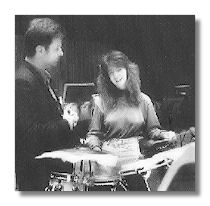
- Tryst tours England on the Contemporary Music Network with the Bournemouth Sinfonietta and Tamás Vásáry. First recording of Confession of Isobel Gowdie and Tryst released by Koch Schwann. New works include Sinfonietta for the London Sinfonietta and Veni Veni Emmanuel, a percussion concerto for Evelyn Glennie and the Scottish Chamber Orchestra.
- 1993
- Premiere of Seven Last Words from the Cross in BBC production for Easter, followed by Visitatio Sepulchre and Epiclesis, a trumpet concerto with John Wallace as soloist and the Philharmonia Orchestra conducted by Leonard Slatkin. Featured composer at the Edinburgh Festival. Busqueda staged in Wiesbaden. Recording of Veni Veni Emmanuel wins Classic CD award. Birth of twins Aïdan and Clare.
- 1994
- Brittania premiered by London Symphony Orchestra conducted by Michael Tilson Thomas at the Barbican, London. Over thirty performances of this overture take place in the UK. Small piece for the renowned Kronos Quartet entitled Memento is premiered in New York. German premiere for Veni Veni Emmanuel followed by first U.S. performances with Mstislav Rostropovitch conducting.Rostropovitch asks MacMillan to write two scores: a cello concerto for him to play and a symphony for him to conduct. Seven Last Word from the Cross televised nightly during Holy Week and premiered in Glasgow.
- 1995
- Completes the opera Inés de Castro, world premiere to take place at the Edinburgh Festival performed by Scottish Opera. Appears at Huddersfield Contemporary Music Festival where Veni, Veni Emmanuel and ….as others see us are performed enthusiastically by students of the University with Gary Warburton as soloist. MacMillan conducts all MacMillan concert in Gdansk including a new version of Tuireadh for string orchestra.
- 1996
- Release of The Berserking CD on BMG Classics. World Premiere performances of Inés de Castro, which is a public success but proves controversial for its blending of traditional narrative structure with post modern musical style, The Worlds Ransoming and Rostropovitch performing The Cello Concerto.
- 1997
- 100th performance of Veni Veni Emmanuel takes place. World Premieres for Ninian, written for clarinetist John Cushing, I (A Meditation on Iona) and Fourteen Little Pictures. Featured composer at the Bergen festival. World Premiere of first symphony Vigil completing the tryptch of works for Rostropovitch and the LSO, entitled Tridium. 20 works performed at the Raising Sparks festival in London, the festival being named after the song cycle for Jean Rigby and the Nash Ensemble. Accepts position as artistic director with RSNO.
- 1998
- Premiere of Why is this night different? by the Maggini Quartet and orchestral version of Cantos Sagrados by RSNO in Glasgow.
Recordings
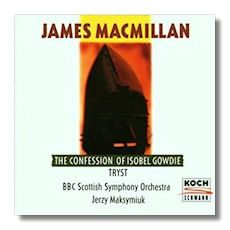
- The Confession of Isobel Gowdie / Tryst
-
BBC Scottish Symphony Orchestra / Jerzy Maksymiuk
Koch Schwann CD 310502
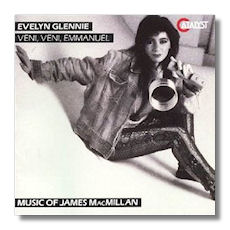
- Veni Veni Emmanuel / …as others see us… / Three Dawn Rituals / After the Tryst / Untold
-
Evelyn Glennie / Scottish Chamber Orchestra / Jukka-Pekka Sarasate / James MacMillan
BMG Catlayst 09026-61916-2
- Visitatio Sepulchre / Busqueda
-
Scottish Chamber Orchestra / James MacMillan
BMG Catalyst 09026-62669
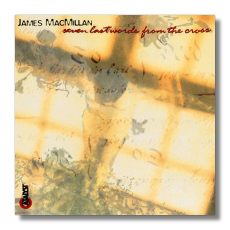
- Seven Last Words from the Cross / Cantos Sagrados
-
Polyphony / London Chamber Orchestra / Christopher Bowers-Broadbent / James Macmillan
BMG Catalyst 09026-68125-2
- The Excorcism of Rio Sumpul
-
Paragon Ensemble / David Davies
Continuum CCD 1031
- Kiss on Wood
-
Maria Bachmann / Jon Klibonoff
BMG Catalyst 09026-62668-2
- Piano Sonata
-
Rolf Hind
Factory Classical FACD 326
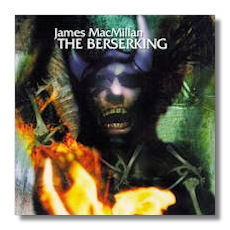
- The Berserking / Sowetan Spring / Sinfonietta / Brittania
-
Peter Donohoe / Royal Scottish National Orchestra / Marius Stenz / James MacMillan
BMG Catalyst 09026-68328-2
Future Performances
- February 4th 1998: Auditorium RAI, Turin Three Dawn Rituals
- Ensemble Novecent / Antonio Ballista
- February 7th 1998: Gateshead Memento
- Edinburgh Quartet
- February 20th and 21st 1998: Buffalo, New York Bùsqueda and Cantos Sagrados
- Musica Sacra / Jack Leoudwin
- March 3rd, 4th and 5th 1998: Aberdeen, Dundee and Edinburgh Veni Veni Emmanuel
- Colin Currie, percussion / Scottish Chamber Orchestra
- March 5th and 6th 1998: Trommen, Horsholm and Tivoli, Copenhagen Veni Veni Emmanuel
- Uffe Savary, percussion / Copenhagen Philharmonic Orchestra / Morten Friis
- March 21st 1998: Glasgow Cathedral Cantos Sagrados (Orchestra version)
- Patricia MacMahon, sop / Royal Scottish National Orchestra / Christopher Bell
- March 22nd and 24th 1998: Ediburgh and Glasgow Tuireadh / Seven Last Words from the Cross
- John Cushing, clarinet / Paragon Ensemble
- March 25th and 27th 1998: RNCM, Manchester Bùsqueda
- Student new music ensemble
- March 26th, 27th, 28th and 29th 1998: New Brunswick, NJ, Trenton, NJ, New Jersey Performing Arts Centre, NJ Veni Veni Emmanuel
- Evelyn Glennie, percussion / New Jersey Symphony Orchestra / Eiji Oue
- April 23rd 1998: Wigmore Hall, London Why is this night different?
- Maggini Quartet
- April 24th 1998: Adrian Boult Hall, Birmingham Why is this night different?
- Maggini Quartet
- May 6th 1998: Shrewsbury School Why is this night different?
- Maggini Quartet
- May 20th 1998: Brunel University Why is this night different?
- Maggini Quartet
- May 30th 1998: Vancouver Why is this night different?
- Maggini Quartet
- June 6th 1998: Vancouver The World's Ransoming
- CBC Symphony Orchestra
- June 6th 1998: Vancouver Seven Last Words from the Cross
- Vancouver Chamber Singers / Vancouver Symphony Orchestra
~ Copyright © David Charlton, 1995, 1996, 1998. If you have any comments, additions or questions I would be really pleased to hear from you! This is the 'Unofficial' Web Page for James MacMillan. The music of James MacMillan is published by Boosey and Hawkes. The Scottish Music Centre is a good site to look for more information about MacMillan and other Scottish composers! Source attribution: Eckhard van den Hooyen, Boosey and Hawkes.