The Internet's Premier Classical Music Source
Related Links
- Latest Reviews
- More Reviews
-
By Composer
-
Collections
DVD & Blu-ray
Books
Concert Reviews
Articles/Interviews
Software
Audio
Search Amazon
Recommended Links

Site News
Site Search
Follow us on


Affiliates








 CD Review
The Historical Record II

An exceptionally interesting disc (Pearl 0067) is testimony to the remarkable legacy of the great voice teacher of the late 19th century, Mathilde Marchesi (1863-1940). Her pupils were mostly lyric sopranos, and all of them displayed the hallmarks of her teaching: evenness of tone production throughout the chest, middle, and head registers, precision of attack and intonation, and perfect trills in which both notes are given equal value (for a good example, listen to Ellen Beach Yaw singing Masse's "Nightingale Song"). Some of her students became famous (Alda, Calvé, Eames, Kurz, Melba), others were less well known (including Mathilde's daughter Blanche and one tenor, John Freestone). The 21 selections on the disc were well chosen to display the vocal characteristics of each of the 16 singers represented, though the acoustic horn was more congenial to some than to others. Melba's studio recordings usually make her sound soulless, but the warmth and excitement that were reported of her performances are apparent in Mimi's "Addio" (from La Bohème), recorded live at her 1926 farewell concert at Covent Garden. Alda's vibrancy and color (in Giordano's "Sempre cosi") and Kurz's spectacular agility and precise placement (in Auber's "Air and Variations") come through with remarkable vividness. The transfers are generally good, though there are lapses of intonation on some tracks that probably come from the recording process rather than the singers. This release is important and valuable for historical performance enthusiasts and for all lovers of vocal artistry.
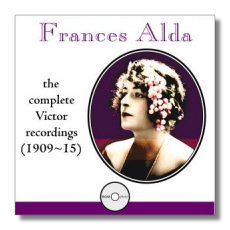
Frances Alda (1883-1952) was married to Giulio Gatti-Casazza, Director of the Met from 1909 to 1935, and her enemies (she had them because she was strong-willed and sharp-tongued) said her long career at that institution was the result of favoritism. This accusation is emphatically disproved by two Romophone discs (81034) containing her Victor recordings from 1909 to 1915, in excellent transfers. Her voice was big enough for dramatic roles and flexible enough for coloratura arias, but she confined herself to the lyric repertory. Like all Marchesi students, she was technically outstanding, with an easy legato, full-voiced and secure at the top, though with a sometimes-heavy vibrato in the middle and low registers. All this is exemplified in "Ah dunque, ei m'amera" from Catalani's Loreley, which she sings with intelligence and sensitivity. Apart from her thrilling high Cs, Alda was not a very exciting singer, but the recording horn was congenial to her forward projection, and as J.B. Steane says, "she was the most consistently satisfying lyric soprano on acoustic records". She still satisfies today.
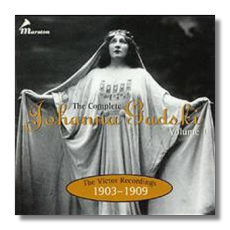
Marston has given us two sets (52002 and 53015, each 2CDs) that contain the recorded legacy of Johanna Gadski (1872-1932), and they provide ample evidence of her exceptional artistry. Born in Prussia, she was a mainstay at the Met from 1900 to 1917 in Wagnerian and other heroic roles. She had a big, weighty voice capable of both open-throated brilliance (in Brüunnhilde's battle cry in Die Walküre) and subtle delicacy (in the "Liebestod" from Tristan und Isolde), and she resolutely sang her roles at a time when declamation had begun to dominate the Wagnerian stage. In arias like "Dich teure Halle" (Tannhaüser), she produces a creamy legato and demonstrates an ability to float pure high notes that is more Italianate in style and feeling than we are accustomed to hearing from German sopranos.
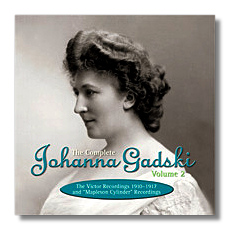
The discs contain a variety of Wagner and Verdi arias, several conventional ballads, and a number of lieder, and while her voice is perhaps too heavy for the last group, Schubert's "Ständchen" is notably tender and moving. The first set includes a rendition of the Death Scene from Aïda, sung with Caruso, that is surely among the most beautiful ever recorded. The second set contains, unexpectedly and notably, arias by Mozart, in which the security, purity, and warmth of her voice are striking. There is a fair amount of surface noise left in the earliest of these transfers, but Gadski's voice seems to have been well suited to the primitive recording technology and comes through vividly. She is under-rated these days in comparison to other singers of her time, and these discs should go a good way toward remedying that situation.
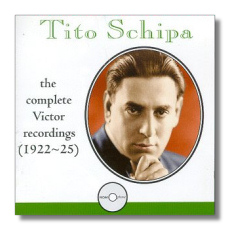
Among the great Italian tenors, Tito Schipa (1888-1965) didn't have the power and range of Caruso, the limpid sweetness of Gigli, or the incisive bite of Martinelli, but he had great charm and perhaps the most seductive voice of them all. He managed his vocal resources with skill and taste, using nuanced phrasing and enunciation (the liquidity of his Italian vowels is remarkable) in persuasive characterizations of the lyrical roles of the operatic repertoire and in irresistible performances of Italian street songs . There are many collections of his recordings available (on RCA, Pearl, Nimbus and other labels), and a recent release from Romophone (82014, 2CDs) is among the best, presenting his Victor recordings from 1922 to 1925 in remarkably effective transfers by Ward Marston. Schipa was more at ease than most in front of the acoustic horn, his smallish voice was well suited to it, and as a result we hear him in sound that is close to the best we hear from Pavarotti or Domingo today. Nobody has ever sung the Serenade from Barber of Seville with more affection, his duets with Galli-Curci are justly famous for their brilliance and beauty (especially "Parigi, o cara" from La Traviata), and he turns the dross of ballads like "O sole mio" into pure gold.
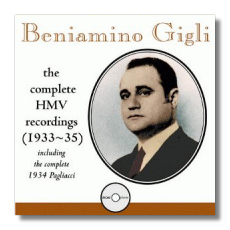
Beniamino Gigli (1890-1957) was the least intellectual and most natural of singers, who displayed his uncomplicated emotions in everything he sang. Sometimes the display was a little vulgar, but it was always in heartfelt response to the music, and it had great audience appeal. It still does, in a recent Romophone set (82017, 2CDs) that contains his HMV recordings from 1933-35 in excellent sound. Still in his 40s, his voice was fresh and sweet, with a lovely warmth in his half voice (in a ravishing "Una furtiva lagrima" from Donizetti's L'Elisir d'amore) and full-throated passion in dramatic arias. The second disc is taken up with a 1934 La Scala I Pagliacci; the sound is antiquated and Franco Ghione's direction is rather sluggish, but Gigli is quite wonderful, Iva Pacetti sings a lovely and well-characterized Nedda, and the whole thing has an Italianate fervor we don't hear much of these days.
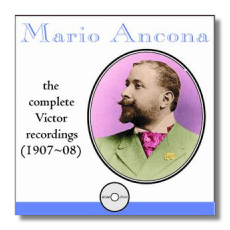
Mario Ancona (1860-1931) was another in the remarkable line of great baritones who flourished in the late 19th and early 20th centuries. He was in many ways an ideal Verdi baritone, with a clear, secure, full-bodied, well-focused voice and a warm, creamy legato that was effortlessly produced, but he also had enough strength and dramatic force for Rigoletto and Don Carlos. He was equally at home in the other Italian and French roles represented in the 23 selections recorded between 1905 and 1908 on a Romophone release (82013). His voice was not flawless; he had an odd way with vowels, there was occasional strain at the top, and he sometimes sacrificed characterization for beauty of tone – but not always, as can be heard in his touching renditions of "A tanto amor"' from Donizetti's La Favorita and "Sei vendicata assai" from Meyerbeer's Dinorah. An admirable singer, and as usual, Ward Marston's transfers are exceptionally good for recordings of this age.
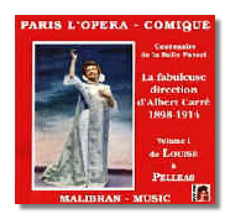
One of the most notable periods in the 300-year history of the Paris Opéra-Comique came between 1898 and 1914, when its brilliant and autocratic director Albert Carré assembled outstanding teams of singers, conductors, and designers to present imaginative performances of the newest and most innovative operas of his time. An exceptionally interesting disc (Malibran 129) presents excerpts from operas that typify Carré's work, recorded between 1929 and 1942. It is more than a mere historical curiosity; I don't think any French operatic recordings close to this quality have been heard since, in Paris or anywhere else. All of the 15 singers represented are exemplars of the French vocal style at its best, with clear, restrained, and well-placed voices, impeccable diction, and expressive attention to the words. The sound is pretty good, and the notes are interesting, though they read better in French than in Franglaise. If you want to hear how French opera should be performed, here is a good place to start.
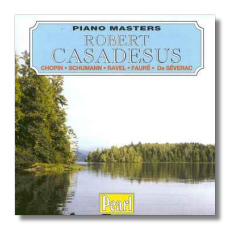
Turning to pianists: Robert Casadesus was the last and greatest exponent of the style sec as it was taught at the Paris Conservatoire, with its emphasis on technical security, precise articulation, and interpretive restraint and objectivity. In lesser hands, it can be dry and uninteresting, but Casadesus infused it with musical understanding and vitality to an uncommon degree. The performances in a release that honors the 100th anniversary of his birth (Pearl 0068) were recorded between 1929 and 1935 and this is their first appearance on CD. He subsequently re-recorded all of these pieces; his interpretations changed very little, though the later ones are in somewhat better sound. His Chopin is notable for its strength and clarity (he said Chopin should be played like Mozart, and that is apparent in what we hear), and there is no better performance of Ravel's glittering Sonatine than this. The whole disc offers just plain wonderful piano playing and should not be missed.
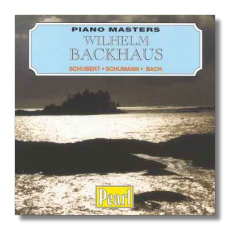
Just as Casadesus is the outstanding example of French piano style, so Wilhelm Backhaus represents the best of the German school, with its emphasis (in Harold Schonberg's words) on "scrupulous musicianship, severity, strength [and] solidity". He played mainly the Central European repertory and was among the first pianists to appear on records; the selections on Pearl 0046 were recorded between 1927 and 1937, and the transfers are good. His Bach and Schumann have an impressive honesty and vitality. You won't find much charm or sensitivity here, but Backhaus embodied a great tradition and expressed its virtues with intelligence and authority.
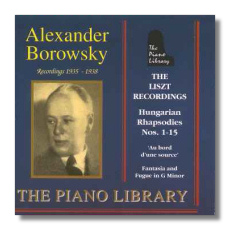
Alexander Borovsky (1889-1968) never achieved quite the reputation he deserved. Born in Latvia and trained at the St. Petersburg Conservatory, he settled in the U.S. in 1941, appeared regularly in public and made many recordings, most of which have never been transferred to CD. But Piano Library 325/26 brings us two all-Liszt discs, recorded in the mid-1930s in adequate sound, containing Hungarian Rhapsodies 1-15 plus three other pieces, including a transcription of Bach's Prélude and Fugue in G minor that I don't remember hearing before. His playing is far from the antiseptic objectivity of today's competition winners; he paid more attention to romance and drama than to linear coherence, using lots of rubato and flexibility of rhythm to achieve a variety of stunning effects. He really seems to be having fun with this music, and so will you.
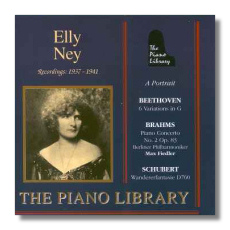
The German pianist Elly Ney (1882-1968), almost Borovsky's exact contemporary, is quite different. She studied with Leschetizky and Sauer and had a considerable international reputation as an interpreter of Chopin, Brahms, and especially Beethoven. But while Borovsky may have been having fun, judging by what we hear on Piano Library 329 Ney was sober, straightforward, and apparently humorless. She could even be stodgy, as in a dull performance of Brahms' Concerto 2; but a set of Beethoven variations (WoO 70) is elegant and graceful, and her "Wanderer" Fantasy (Schubert) is robust and thoughtful. I'd still rather listen to Borovsky.
Copyright © 2000, Alexander J. Morin.