Site Search

Affiliates

In association with
Amazon
Amazon UKAmazon GermanyAmazon CanadaAmazon FranceAmazon Japan

ArkivMusic
CD Universe


Sheet Music Plus Featured Sale

Classical Sheet Music


News & Information

Recently in Performers Category

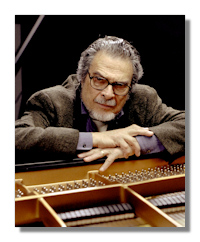
Leonard Pennario, Classical Pianist

|
Primrose, Heifetz, Pennario, and Piatigorsky

Leonard Pennario, 83, Classical Pianist, Dies

By James Barron
New York Times

Leonard Pennario, a popular classical pianist known for his enthusiastic public performances and recordings of the more melodic modern composers, died on Friday in La Jolla, Calif. He was 83.

The cause was complications of Parkinson's disease, said Mary Kunz Goldman, who is writing his biography.

Mr. Pennario, who also became a life master in tournament bridge, was listed in both the New Grove's Dictionary of Music and The Official Encyclopedia of Bridge. As a pianist, he made many recordings in the days of long-playing records, notably of works by Gershwin and Rachmaninoff, and appeared with well-known orchestras and conductors. Beginning in the 1960s, he also played in trios with the violinist Jascha Heifetz and the cellist Gregor Piatigorsky.

Mr. Pennario made more than 60 recordings in all, of music by composers as diverse as Bela Bartok and Louis Moreau Gottschalk. Ms. Goldman said he was the first pianist after Rachmaninoff himself to record all four Rachmaninoff concertos and the "Variations on a Theme of Paganini."

Read more about this at the New York Times website:

   http://www.nytimes.com/2008/06/28/arts/music/28pennario.html

A Romance on Three Legs

|
Glenn Gould at the piano

The hunt for the perfect instrument

[Glenn Gould adored his Steinway concert grand No. 318 – then the movers smashed it…]

By John Terauds
Toronto Star

Katie Hafner's suggestively titled book – A Romance on Three Legs: Glenn Gould's Obsessive Quest for the Perfect Piano – is like an executive summary for which someone has condensed all the need-to-know information into a tidy package. In this case, the perplexing eccentricities of Glenn Gould, both man and artist, are wrapped around one of his chief obsessions: finding the right piano.

To get into the spirit, try to imagine how a favourite paintbrush or garden spade feels in your hand. Or consider how your bicycle or car responds to your body's inputs.

Tactile memory is our window on the intimate sensual relationship that a musician has with his or her instrument. Because they're made from wood and other climate-sensitive materials, most instruments end up with a unique touch, sound and personality.

Read more about this at the Toronto Star website:

   http://www.thestar.com/article/447016

Classical Club Scene

|
Gabriel Prokofiev

Gabriel Prokofiev's Nonclassical club night breaks with tradition

Club nights are taking the starch out of live classical music

By Femke Colborne
Times Online

The girl taking tickets on the door is wearing odd stockings. It's the middle of June, but one of the bar staff is sporting a woolly hat, complete with a strategically draped bobble. It's 9.30pm on a Wednesday night at the Macbeth on Hoxton Street, and this is exactly the kind of crowd you'd expect to find in this terrifyingly trendy corner of East London. It's not what you'd expect at a classical music concert, though.

But this is no ordinary classical music concert. Nonclassical, run by Gabriel Prokofiev, DJ, producer, composer and grandson of the great Sergei, is a monthly classical club night that mixes live performances from instrumentalists and singers with sets from electronica DJs. Talking during the performances is not frowned upon – in fact, it's positively encouraged – and drinks are served at the bar throughout the night.

The event is just one of a host of classical club nights springing up in cities across the country, aimed at younger punters who are open to classical music but deterred by the formality of the traditional concert hall. According to Prokofiev, young people are put off going to formal concerts because they don't know what to wear or when to clap, and hate being forced to sit in silence throughout a performance.

Read more about this at the Times Online website:

   http://entertainment.timesonline.co.uk/tol/arts_and_entertainment/music/article4121930.ece

Oooo, That's Scary

|
Moog Theremin

Ghost in the machine

They make the sound of aliens, magic and the cosmic unknown. But just how do you get music out of the theremin and the ondes Martenot?

By Pascal Wyse
Guardian UK

In Pamelia Kurstin's Vienna apartment, I have my back up against the wall and am attempting not to breathe. My hands are stuck in mid-air like a neglected shop dummy, and I am told to imagine I'm in a tub of "very thick fluid". Before me is what could be a little robot with two antennae. I carefully reach out towards it and it makes a seasick whooping sound.

Kurstin lets out the first of many enormous giggles. She is giving me a lesson on the theremin: an early electronic instrument that became the universal sound of aliens, ghosts and other voices from the B-movie ether.

Read more about this at the Guardian UK website:

   http://arts.guardian.co.uk/filmandmusic/story/0,,2281481,00.html

Love Triangle

|
Percussionists

Making noise

Misunderstood and underappreciated, percussion players step forward to tell their story.

By Graydon Royce
Star Tribune

For three hours, Joe Nathan sits and watches the Minnesota Twins play ball. Then, the relief pitcher is asked to get three quick outs in the ninth inning. In 2007, the Twins played 1,458 innings. Nathan pitched in 72. Yet if he fails, a victory is lost. He is indispensable to the club.

Imagine now the percussionist perched at the back of the Minnesota Orchestra. He waits in fretful anticipation as the instruments around him furiously exhaust themselves, playing Mahler's Ninth Symphony. Finally, Osmo Vänskä fixes his eyes on the percussion section and gestures for the cymbals.

Read more about this at the Star Tribune website:

   http://www.startribune.com/entertainment/music/19101244.html

Great Music and Fine Food

|
Fine Food

The best meals and the best music make up a menu for the senses

By Paul Horsley
Kansas City Star

It's the night before Dubravka Tomsic's recital on the Friends of Chamber Music's piano series, and dinner is served.

The guests have worked up a sharp hunger in the living room with appetizers of Cognac-cured salmon on cocktail loaf, spread with butter-horseradish mustard.

Hosts Cynthia Siebert and Larry Hicks have spent the day preparing a gourmet meal for their guests, among them the Slovenian pianist who the next night would deliver two hours of stellar pianism to a Folly Theater audience.

Such dinners are an integral part of the Friends series, Siebert said, engendering a relationship that nourishes body and soul.

Read more about this at the Kansas City Star website:

   http://www.kansascity.com/654/story/621942.html

Concert for the Lost & Found

|

Cabdriver Thanked for Returning a Stradivarius

By Richard G. Jones
New York Times

Newark, New Jersey – The violinist stood on a makeshift stage between two lampposts crowned with a patina of bird droppings, under a weathered vinyl canopy hastily erected outside Newark Liberty International Airport in the taxicab holding area. The audience watched him in awe, about 50 drivers in three rows, their yellow cabs a few feet behind, some lined up neatly, others askew.

As Philippe Quint spent half an hour playing five selections, the cabbies clapped and whistled. They danced in the aisles, hips gyrating like tipsy belly dancers. "Magic fingers, magic fingers," one called out. Another grabbed the hand of Mr. Quint's publicist and did what looked like a merengue across the front of the "stage."

Afterward, the virtuoso was mobbed by drivers seeking his autograph on dollar bills, napkins and cab receipts.

"It was so pleasing to see people dancing – that never happens," said Mr. Quint, 34, a Grammy-nominated classical violinist. "These people, they work so hard, I doubt they get a chance to get out to Carnegie Hall or Lincoln Center."

So Mr. Quint took Carnegie Hall to them, in a miniconcert that was his way of expressing a simple sentiment: Thank you.

Read more about this at the New York Times website:

   http://www.nytimes.com/2008/05/07/nyregion/07violin.html

Performers to the Rescue

|
Kristjan Jarvi, by Peter Rigaud

More power to the performer

By Matthew Westwood
The Australian

Classical music, as it grew progressively more complex through the romantic period onwards, evolved into a mind game where the composer always had the psychological lead.

Musical scores came to be written as if dogma, down to the last pedantic detail; performers, even brilliant ones, became mere instruments to the composer's vision.

That may be a bleak view of the concert hall. But Kristjan Jarvi, the energetic Estonian-born conductor, is disdainful of the pseudo-intellectualism of some contemporary music and the "academic blackmail" to which it subjects performers.

The pianist and conductor is doing his bit to address the perceived imbalance between composer and musician. It's not so much a contest of wills as a spectator sport in which music as well as audiences should benefit.

"It is really important to make the performers feel that they have freedom, that they can express music rather than just play the notes," Jarvi says on the phone from Hanover, Germany.

Read more about this at The Australian website:

   http://www.theaustralian.news.com.au/story/0,,23624489-16947,00.html

A Revolutionary Orchestra

|
Parkdale Revolutionary Orchestra by Susan Carey

Bold approach breathes new life into classical music

There's nothing so off-the-wall that somebody hasn't thought of it

By Nigel Hannaford
Calgary Herald

Mitzi's Sister is a small club in the Parkdale area of Toronto. Home cooking, a stage, it holds 150 people. Small as these things go. But, it was there just over three years ago, that Parkdale Revolutionary Orchestra first took the stage.

Big moment in the history of music? Too early to say.

However, a few weeks ago, this space dealt with the sort of music that can pay its own way, with no top-ups from the Canada Council. I jested that if classical music was to rescue itself from its socio-economic isolation – its audience shrinks, as it ages – it would have to rebrand itself as something risque, to be enjoyed in seedy little rock-clubs where it's best to sit near an exit, with one's back to the wall. Only when it could make it without a grant, could it once more be considered an expression of contemporary culture.

But, irony is hard these days. There's nothing so off-the-wall that somebody else hasn't thought of it, or done it.

Read more about this at the Calgary Herald website:

http://www.canada.com/calgaryherald/news/theeditorialpage/story.html?id=73bb2c7e-5843-4d53-a99e-119ea7fd7546

The Sexy Side of Classical Music

|
Violinist Janine Jansen by Mitch Jenkins

Saint Louis Symphony Orchestra: A Sex Appeal

By Eddie Silva
Playbill Arts

Let's talk about sex – and classical music.

A couple of years ago the writer Greg Sandow, who discusses the state and fate of classical music on artsjournal.com, alerted his readers to the emergence of an audacious new feature in MUSO, a magazine based in the UK that writes about the classical music world the way Spin writes about rock & roll. In MUSO's online version, Sandow heralded, is a section called "G Spot," which features a list of fans picks for sexiest soloists, with pictures and commentary.

For example, violinist Joshua Bell is described to be "As American as apple pie and just as tasty." Pianist Hélène Grimaud is praised for her "gamine gaze." Room is left for praise of the artists' musicianship, "supreme skills across an extraordinary range of repertoire" and "steely pianistic strength," but the message MUSO spreads is that having one gift does not belie the other. And, more importantly, classical can be hot.

Classical music is declared dead, usually with deep regret, by some astute and erudite critic on a regular basis. And just as it is declared dead, it is passionately declared alive and well by another astute and erudite critic – usually the next day. Death and resurrection is a great theme of religion and literature, but a steady dose of it can be emotionally depleting, especially if it happens to be your art form being compared to Lazarus. Within the chronicling of the death-life continuum of classical music, at least one fact is inarguable: classical music's presence near the center of popular culture has diminished considerably over (at least) the last two decades.

Read more about this at the Playbill Arts website:

   http://www.playbillarts.com/features/article/7621.html

Trumpet