The Internet's Premier Classical Music Source
Related Links
- Prokofieff Reviews
- Latest Reviews
- More Reviews
-
By Composer
-
Collections
DVD & Blu-ray
Books
Concert Reviews
Articles/Interviews
Software
Audio
Search Amazon
Recommended Links

Site News
Site Search
Follow us on


Affiliates









 DVD Review
Serge Prokofieff
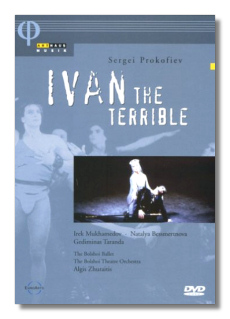
Ivan the Terrible, Op. 116 (Ballet)
- Ivan: Irek Mukhamedov
- Anastasia: Natalya Bessmertnova
- Prince Kurbsky: Gedminas Turanda
Bolshoi Ballet
Childrens Choir of the Bolshoi Theater
Bolshoi Theater Orchestra/Algis Zhuraitis
Yuri Grigorovich, scenario and choreography
Simon Virsaladze, scenery and costumes
Arthaus Musik DVD 101107 LPCM Stereo 113min Full Screen


This is a strange review to write, so let's start at the beginning. Read the title line to the headnote. It credits this ballet, Ivan the Terrible, to Serge Prokofieff. But what we have here is an adaptation – often, a very free adaptation – of Prokofieff's film score to Sergei Eisenstein's two-part film about Ivan the Terrible. (a third part was planned but never made.) The adaptation was made Mikhail Chulaki, who also drew heavily on music from Prokofieff's Third Symphony, Russian Overture and Alexander Nevsky. Whenever the ballet score closely follows Prokofieff's originals, the orchestration is almost invariably different in some way. Thus, in the end, we get an episodic arrangement of themes and sections from Prokofieff's music.
There are, of course, parallels in ballet for this kind of thing, Les Sylphides being the most prominent example. Who actually expected a ballet from Prokofieff's film music – or Stasevich's famous arrangement of it – without some adjustments, that is, without undanceable parts excised or altered? At any rate, the big question here is, what are the music and dancing like? For all Chulaki's takeoffs and tampering, his work is colorful and quite imaginative. Prokofieff purists might scoff at it, but I, an admirer of the composer's music for a half-century or so now, find it a compelling mixture of the enchanting and the riveting. It may lack depth, but Chulaki has fashioned a score that most 20th century ballet aficionados should find appealing. The dancing, as you expect from the Bolshoi, is brilliant, with both leads, Irek Mukhamedov and Natalya Bessmertnova, as well ensemble dancers, turning in impressive performances. The choreography and scenery are imaginative, though the latter is tinged with a bit of drabness.
There are long sections from Prokofieff's various scores that are presented with relatively few changes, #7 (track 8) – Celebrating the victory (from the Russian Overture); #9 – Ivan's fortune (from Symphony #3, second movement); and #10 – Revolt of the Boyars (Symphony #3, third movement); and #16 – Finale (Symphony #3, finale). So, lest I leave the reader with a false impression, there is a lot a fairly straight Prokofieff here. In fact, as the score progresses it becomes clear that Chulaki relies more and more on Prokofieff and less on himself. I should point out that the booklet notes, apparently written by Boris Kehrmann, claim that #15, Dance of the Oprichniki (from Ivan the Terrible) is unchanged from the film score. Kehrmann was probably referring to one small section in #15, but even though the music closely follows Prokofieff here, extra percussion and other instrumental effects are added by Chulaki.
As for conductor Algis Zhuraitis, his interpretation is generally insightful and the performance he draws from the Bolshoi Theater Orchestra is spirited. Some of the tempos vary from Prokofieff's original scores (the dark opening of #13, Ivan at Anastasia's grave, is taken too fast), but one cannot tell if Chulaki altered the tempo marking to make the music more danceable or if Zhuraitis stepped on the accelerator. At any rate the performance is fine overall, and the sound, from this 1990 live Bolshoi Theater presentation, not quite state-of-the-art but clear and full. Recommended.
Copyright © 2005, Robert Cummings