The Internet's Premier Classical Music Source
Related Links
-
Marenzio Reviews
Palestrina Reviews
Victoria Reviews - Latest Reviews
- More Reviews
-
By Composer
-
Collections
DVD & Blu-ray
Books
Concert Reviews
Articles/Interviews
Software
Audio
Search Amazon
Recommended Links
Site News
Site Search
Follow us on


Affiliates








 SACD Review
Roma Triumphans
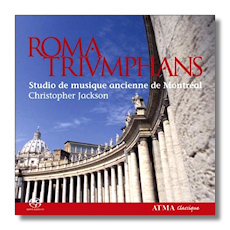
Sacred Music from Rome
- Luca Marenzio:
- Super flumina Babylonis
- Lamentabatur Jacob
- Giovanni Pierluigi da Palestrina:
- Laudate pueri
- Jubilate Deo
- Giovanni Giorgi:
- Terra Tremuit
- Haec Dies
- Veni Sancte Spiritus
- Vincenzo Ugolini:
- Beata es Virgo Maria
- Exultate omnes
- Quae est ista
- Tomás Luis de Victoria: Laetatus sum
- Orazio Benevoli: Missa Dominus Angeli: Gloria
Studio de musique ancienne de Montréal/Christopher Jackson
Atma Classique SACD2-2507 61:34 Hybrid Multichannel SACD


As its title suggests, this music is associated with Rome – specifically, with the Vatican and affiliated churches – during the1500s, 1600s, and early 1700s, when Renaissance and then Baroque art was at its peak. The use of multiple choirs or cori spezzati originated not in Rome but in Venice, but it soon came to the Holy City and triumphed. Some composers wrote motets and masses for as many as ten choirs. All of the music on this SACD, however, was composed for only two or three.
Although the Roman Catholic church approved of sacred music, composers worked under certain restrictions. One promulgated by the Council of Trent was that polyphony must not obscure the Latin texts. In other words, no matter how many choirs were singing, the text needed to remain intelligible, otherwise the spiritual message that it contained would be lost. Palestrina probably was the first composer to negotiate this restriction with consistently brilliant success. All of the other composers represented here are Palestrina's descendants, so to speak, and his influence on them, direct or indirect, was considerable.
Also in keeping with the Council of Trent, these works are unaccompanied, with the exception of those by Benevoli, Giorgi, and Ugolini, and those use only a basso continuo – here, theorbo, cello, and positive organ. (These are played by Sylvain Bergeron, Karen Kadevarek, and Réjean Poirier, respectively.)
Roman church choirs also are unlikely to have included women among their members during this period. In fact, to this day, the papal choir consists exclusively of men and boys. The Studio de musique ancienne de Montréal (or SMAM, as they sometimes call themselves) is a mixed-gender ensemble, and so its performances of this repertoire break with authenticity. I'm not complaining, though, because my experience with papal choirs (limited largely to the annual Christmas mass on television, I admit) tells me that its boys are enthusiastic, but its sound is not very refined! That's not something one can say of SMAM, whose sound is as clean and polished as its interpretations are sensitive. Thirteen singers are listed, which means that the performances are one voice to a part. That's probably inauthentic, too, but there's nothing puny about the sound, and somehow, the results sound bigger than one might expect.
SMAM's Heavenly Spheres CD (released by CBC Records in 1998) is one of the most beautiful recordings of Renaissance choral music ever released. Roma Triumphans is not quite on the same level, but nevertheless is another feather in the cap of this worthy ensemble.
Copyright © 2008, Ray Tuttle